
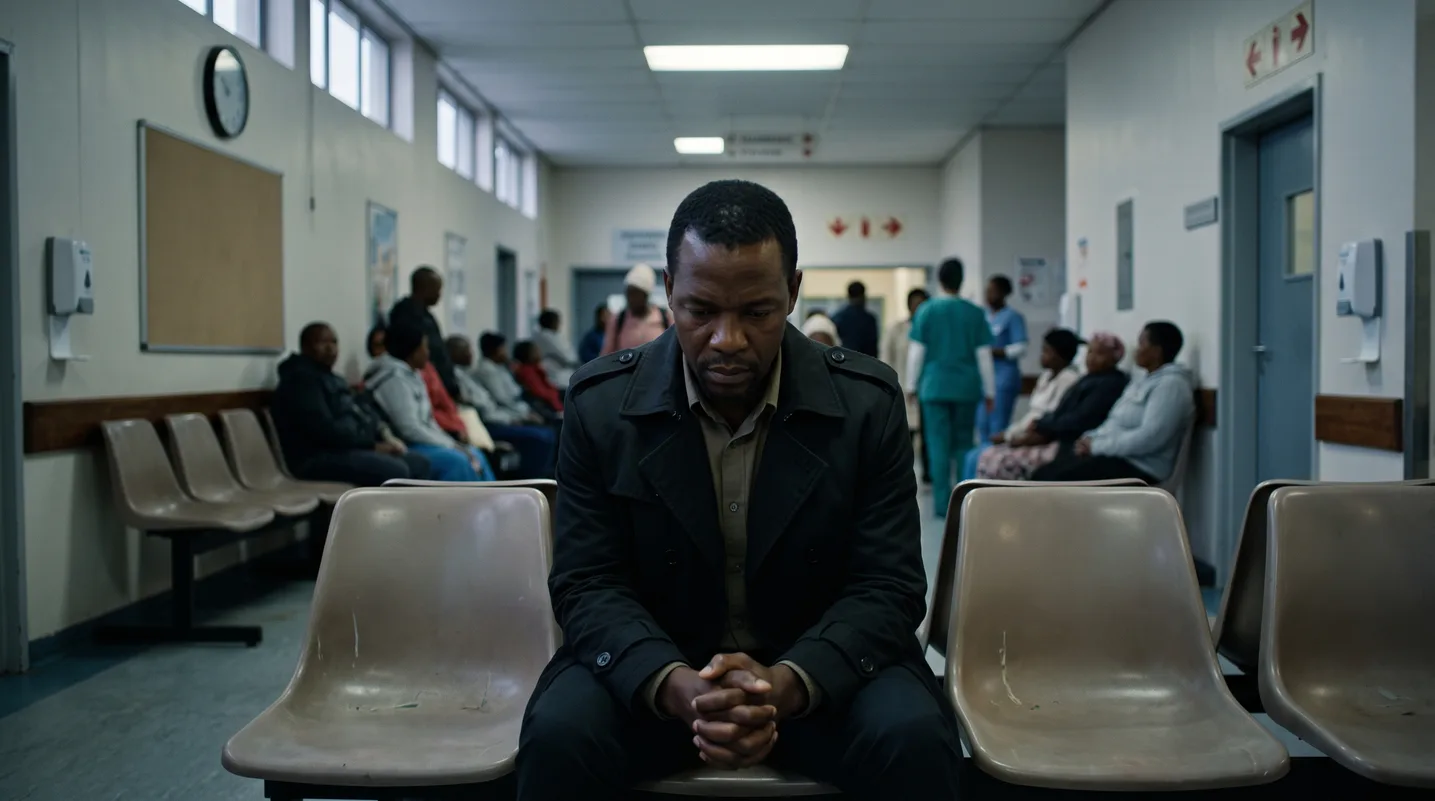
The front door of mental healthcare is a hospital casualty ward or outpatient queue
What the parliamentary record shows, and what it can't
Hakeem Lesolang
(Subscribe on Substack)Hypnotherapist & Peak Performance Coach
Who this is for: professionals and parents who have been running on a tight reserve, who tell themselves they will deal with it when things calm down, and who are not sure whether what they feel is "bad enough" to ask anyone about.
Picture an ordinary Sunday evening. The school clothes are ready. Tomorrow's meetings are in the diary. You have answered the message that needed answering, checked the account that needed checking, and put another person's worry somewhere ahead of your own. Nothing is visibly falling apart. That is part of the difficulty.
You sit down, but you do not feel rested. The thought of Monday has already entered the room. Someone asks whether you are all right and you give the answer that keeps the evening moving: just tired. You make a private agreement with yourself. After this deadline. After this month. When things settle.
This is an imagined scene, not a client's story. It names a question worth asking before we discuss a country's hospital queues: what do we allow to count as a reason to seek care? If the answer is only collapse, functioning becomes a convincing disguise. The bills are paid, the children are fed, the work gets done. Those facts matter. They do not tell the whole truth about the person doing it.
The Minister of Health's own written reply says all 3,783 public health facilities in South Africa offer mental health services within their capacity. In the same month, a second reply showed regional hospitals treating nearly 200,000 mental health-related cases a year in their emergency and outpatient departments. Both are on the record. The gap between them says something about how a whole country treats its mind, and about how most of us treat our own.
What the record says
In September 2026 the Minister answered two written parliamentary questions from the same MP. Reply NW4256: all 3,783 public facilities offer mental health services within their capacity, including 3,456 of 3,474 primary healthcare facilities (the other 18 are being refurbished). Reply NW4257: regional hospitals treated 175,642 people for mental health-related illness in their emergency and outpatient departments in 2023, 194,126 in 2024 and 196,307 in 2025, a rise of 11.8% over two years, and 97,869 in the first half of 2026. In May, in his budget speech, the Minister said 75% of Community Health Centres have at least one mental health care provider.
What my title claims, and what it can't
The title points at where the load shows up in official figures: regional hospital casualty and outpatient departments. The Department says its system does not separate emergency from outpatient data, so I cannot tell you how many of those cases were emergencies. I also cannot tell you that these are people's first contact with care, and the little evidence there is points the other way. A national survey (data from 2002-04) found general medical providers, meaning doctors and nurses, were the most-used sector among people with a disorder. A 2016 study in rural KwaZulu-Natal found that most people with probable psychosis first consulted traditional healers, and very few began at a hospital. A 2023 study of patients at two Johannesburg psychiatric facilities found that 47% had seen traditional healers before coming. Those studies are small or old and I do not treat them as the national picture. I found no national dataset that measures first point of contact for mental health at all. So read the title as a reading of the numbers: hospital queues are where a large volume of care is recorded, often after people have tried other doors.
Is this only one source talking?
No. People who study the system have described the same shape.
Budget and shape. A 2019 national survey of the public mental health system (Docrat and colleagues, Health Policy and Planning) found mental health took 5.0% of the public health budget in 2016/17, that 86% of mental health spending went to inpatient care, and that about 24% of mental health inpatients were readmitted within three months.
The Department's own words. The 2023-2030 National Mental Health Policy Framework says there is "considerable under-investment in mental health in South Africa", "heavy reliance on psychiatric hospitals" and "major shortfalls in human resources".
The Human Rights Commission. Its 2019 national hearing report found that the largest share of mental health budgets and professionals "continues to be in specialist psychiatric facilities", despite policy that recommends a shift to primary and community care. Parliament's Basic Education committee considered the report on 18 February 2020.
Who gets care. The South African Stress and Health Study found that 25.5% of people with a 12-month mental disorder had received any treatment in that year. The data were collected in 2002-04, so this is a historical marker and not today's rate. Of those treated, the largest share saw a general medical provider (16.6%).
The world view. The World Health Organization's 2022 World Mental Health Report says community-based mental health care is "consistently underfunded", and that scaling up treatment for depression and anxiety gives a benefit–cost ratio of 5 to 1.
The honest caveats
Rising treatment counts are not automatically rising illness. They can mean more people are seeking help, which is something to want. The 2026 figure is six months only. The budget and survey figures are older. The reply does not say whether "patients" means people or visits. And "offered within capacity" is an honest phrase, not a claim that care is easy to reach. I found no committee debate or Hansard on these figures; they are written replies. Nothing here accuses anyone. It is a picture of a system, and the people in it are working hard.
The door we keep closing ourselves
There is evidence for looking beyond the queue to the decision that comes before it. In a 2011 analysis of the South African Stress and Health Study, Belinda Bruwer and colleagues examined barriers to starting treatment. The interviews were conducted in 2002-04. Among respondents who met criteria for a past-year disorder but had not used services, low perceived need was the most common reason for not seeking treatment. The study defined that response as "the problem went away by itself, and I did not really need help."
That wording matters. It does not mean every person was secretly suffering and refusing to admit it. Some may have improved. A retrospective survey cannot tell us which individual should have sought help sooner. But the researchers also examined a much smaller group of 38 people who recognised a need and still did not get treatment. Expecting to get better and judging the problem insufficiently severe were common responses there. Cost, availability and transport were also reported. These are historical findings, not estimates of what South Africans think today.
The point is not to blame people for failing to use an uneven system. The researchers argued for addressing beliefs about care alongside affordable, accessible services. A person needs somewhere to go and a reason to believe that going is allowed. Neither cancels the other.
Here is my reading of that distinction: "I can still function" and "I do not need support" are different statements. We often treat them as identical. You can be competent at work and increasingly absent at home. You can complete a week while dreading the next one. Those are reasons for a conversation, not a diagnosis made by an article.
What this says about your own mind
This is a practitioner's reading, not a finding from the data.
If getting support has felt hard, that is not only a personal failing. The system around you is built unevenly, and waiting is common. That does not make you weak.
The early end is the quiet end. Systems tend to meet people late, when something is loud. We do the same with ourselves. The changed sleep, the shorter temper, the Sunday-evening dread get a shrug and a coffee. These are not small. They are the signal arriving early, while a quieter response still has room to work.
You do not need to be in crisis to ask. Asking early is not an overreaction. It is the same logic as servicing a car before the engine fails.
The rule beneath the postponement
In my earlier Uncommon Practice essay about practising being last, I described working in hypnotherapy with "the felt rules beneath the behaviour." That is the lens I bring here, not a conclusion drawn from the Minister's figures. The rule may be that dependable people do not need anything, or that asking makes you a burden. Saying those rules aloud lets us question them without turning the person who learned them into the problem.
I also wrote: "I can be dependable without being permanently available." That sentence belongs beside the hospital numbers because earlier care asks us to make room for a need before it becomes an emergency. It is not proof that hypnotherapy prevents hospital attendance. I am making no such claim. It is a way of examining the meaning attached to asking, resting and receiving support.
For this essay, the mechanism is a decision rule rather than a claim about a brain circuit: notice a change, dismiss it because you are still functioning, and postpone the conversation again. The research above concerns reported reasons for seeking care, not the physiology of that sequence. Keeping the two separate matters. We do not need to dress an honest question in neuroscience to make it worth asking.
The practical question is smaller than "What is wrong with me?" It is: "What am I requiring myself to endure before I allow another person to know?" There is room to answer that before choosing a practitioner, an assessment or a treatment.
Something you can do this week
Take five minutes tonight, phone away. Write three lines: how I have been sleeping, how I have been with the people closest to me, and what I keep postponing. You are not diagnosing yourself. You are noticing. Then pick one person who would be glad to hear from you and tell them one true sentence about how you are.
If someone close to you has gone quiet, the same small step works. "You haven't seemed yourself lately. I'm here if you want to talk." Said once and calmly, it plants a door. If you live abroad and hear it in a parent's voice or a sibling's silence on the phone, you can still say it.
If you are in immediate danger or worried you may hurt yourself, contact local emergency services or a trusted person now.
How FOLA helps
I am a hypnotherapist. At FOLA Polyclinic I work with professionals and parents on the exhaustion, emotional load and relationship strain that build up quietly, in person in Tshwane or online anywhere in the world. Hypnotherapy is not a replacement for emergency care.
There are two ways to start, and neither asks you to be in crisis:
A free 30-minute discovery call. We talk through what has been happening and whether FOLA is the right fit. calendly.com/folasessions/discovery-call
The Personal Growth Assessment, R600. A 20 to 30 minute assessment from LoveBetter by FOLA Polyclinic, delivered as an instant PDF.
Sources
Parliamentary question NW4256 to the Minister of Health (reply, 11 Sep 2026): https://pmg.org.za/committee-question/40483/
Parliamentary question NW4257 to the Minister of Health (reply, 11 Sep 2026): https://pmg.org.za/committee-question/40484/
Minister of Health budget speech, 13 May 2026: https://pmg.org.za/briefing/42991/
Docrat S et al. Mental health system costs, resources and constraints in South Africa: a national survey. Health Policy and Planning, 2019: https://pmc.ncbi.nlm.nih.gov/articles/PMC6880339/
National Mental Health Policy Framework and Strategic Plan 2023-2030, Department of Health: health.gov.za
South African Human Rights Commission, Report of the National Investigative Hearing into the Status of Mental Health Care in South Africa, 2019: sahrc.org.za
Portfolio Committee on Basic Education report on the SAHRC report, 3 March 2020: https://pmg.org.za/tabled-committee-report/4084/
Twelve-month treatment of psychiatric disorders in the South African Stress and Health Survey: https://pmc.ncbi.nlm.nih.gov/articles/PMC3222914/
Mental health service use among South Africans for mood, anxiety and substance use disorders: https://pmc.ncbi.nlm.nih.gov/articles/PMC3192004/
Psychosis and help-seeking behavior in rural KwaZulu Natal, International Journal of Mental Health Systems, 2016: https://ijmhs.biomedcentral.com/articles/10.1186/s13033-016-0089-z
Pathways to care among patients with mental illness at two psychiatric facilities in Johannesburg, International Journal of Social Psychiatry, 2023: https://pmc.ncbi.nlm.nih.gov/articles/PMC12415844/
World Health Organization, World Mental Health Report: Transforming mental health for all, 2022: who.int
Bruwer B et al. Barriers to Mental Health Care and Predictors of Treatment Dropout in the South African Stress and Health Study. Psychiatric Services, 2011 (SASH data, 2002-04): https://pmc.ncbi.nlm.nih.gov/articles/PMC3448366/
Practitioner language: Hakeem Lesolang, You Are Not Waiting for the Right Time. You Are Practising Being Last., The Uncommon Practice, 19 September 2026: https://lovebetter.co.za/the-uncommon-practice/you-are-practising-being-last
Share this post
Ready to talk about what you just read?
Book a free discovery call with Hakeem Lesolang. No pressure. No pitch. Just an honest conversation about where you are and where you want to be.
Book Your Free Discovery Call